Awareness First
We start every program with a focus on observation rather than action. Before making changes, participants explore their current patterns, habits, and responses without judgment or pressure.
Our programs are built on the principle that understanding your own well-being is a learned skill. Through structured workshops, we provide the frameworks and reflection tools to help you develop that understanding at your own pace.
We start every program with a focus on observation rather than action. Before making changes, participants explore their current patterns, habits, and responses without judgment or pressure.
Educational content is structured to give participants a working vocabulary for discussing mental wellness. This includes evidence-informed concepts, not clinical frameworks or diagnostic language.
All group workshops operate within clear boundaries. Facilitators are trained to maintain a structured, respectful environment where participants feel comfortable engaging at their own level.
Participants are never pushed toward a particular conclusion. Our role is to provide structure and content; the meaning and application of each session is something each participant develops independently.
Group formats are designed to create a sense of shared learning. Hearing how others engage with the same material often provides context that individual study alone cannot replicate.
Our programs include structured follow-up materials designed to extend the reflection process beyond the session itself. Learning about well-being is a gradual, iterative process, not a single event.
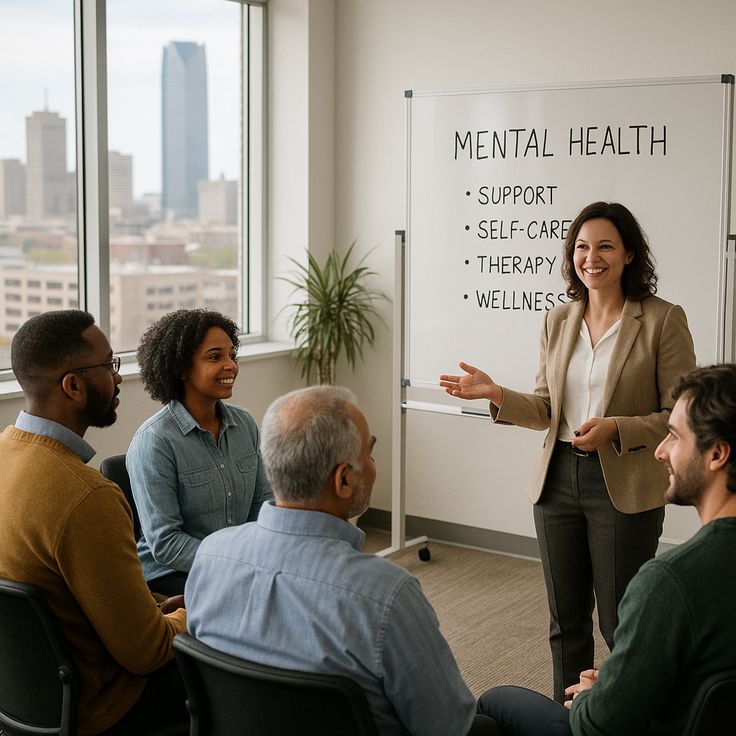
Our facilitators are experienced in structured group processes and educational delivery. They guide discussions, introduce frameworks, and invite reflection — but they do not direct participants toward specific personal conclusions, diagnoses, or prescribed outcomes.
Each program type follows a consistent framework while allowing flexibility in topic areas and participant direction.
Every session begins with a clear statement of the session’s educational purpose, expected format, and ground rules. Participants are reminded that the content is informational only, and that any personal reflections shared within the group remain confidential within the group setting.
The facilitator introduces the session’s main concept using accessible language and a brief reference to relevant educational frameworks. Visual aids, examples, and structured prompts are used to make abstract concepts tangible and relatable.
Participants engage in a facilitated reflection exercise — this may involve written prompts, paired discussion, or group sharing, depending on the session format. The focus is always on exploration, not on arriving at any particular answer or conclusion.
Where the format allows, participants have the opportunity to share observations or questions with the wider group. The facilitator manages this phase to ensure a constructive, respectful dynamic and to link individual contributions back to the session’s educational theme.
Each session closes with a brief summary of the concepts covered and a structured set of reflection questions or journal prompts for participants to continue with independently after the session ends. These materials are provided in writing.
Within 48 hours of each session, participants receive a summary document including the session’s key concepts, suggested further reading (sourced from publicly available, non-clinical literature), and an optional feedback form to help us continually improve our programs.
Our programs address four interconnected areas of personal well-being. Each pillar is explored through an educational, non-clinical lens.
Understanding how thoughts, attention, and daily patterns influence the experience of well-being over time.
Examining how daily structure, sleep, movement, and rest interact to support or detract from a sense of balance.
Exploring how interpersonal communication styles and relationship dynamics connect to our broader sense of wellbeing.
Frameworks for reflecting on personal values, motivation, and the relationship between meaningful activity and overall well-being.
Group workshops create a shared learning environment that individual study cannot replicate. Participants consistently note that hearing different perspectives on the same topic deepens their own understanding.
All group sessions are professionally facilitated to ensure productive, respectful discussion.
Group-sharing norms are established at the start of every session to protect participant privacy.
Our workshops bring together participants from various professional and personal backgrounds.
Multi-session programs allow participants to build on earlier discussions over time.
No. Our workshops are educational programs, not therapeutic or clinical services. They are designed to provide frameworks and information about mental wellness concepts. If you are experiencing mental health difficulties, we encourage you to consult a qualified healthcare professional. Our programs are a supplement to, not a substitute for, professional support.
Our programs are designed for adults who have a general interest in mental wellness education and are looking for structured, facilitated formats to deepen their understanding. No prior knowledge of psychology or wellness concepts is required. Programs are not designed for individuals currently in active mental health crisis, who are better served by professional clinical support.
Our facilitators hold relevant qualifications in education, group facilitation, and wellness instruction. They are not licensed therapists or clinical psychologists, and do not provide clinical services. All facilitators receive ongoing training in structured facilitation techniques, group dynamics, and the responsible delivery of educational wellness content.
Most sessions are conducted in English. Norwegian-language sessions are available for certain group formats upon request. Please specify your language preference when making your enquiry and we will do our best to accommodate.
Yes. All of our programs are available in an online format delivered via secure video conference. Online participants receive the same materials and facilitator access as in-person attendees. Some multi-session programs may have a mix of in-person and online sessions; this is specified in each program’s details.
View the full catalogue of workshops, formats, and educational programs currently available at Ligamentflushing.
All programs are informational only. Not a substitute for professional healthcare.